SerenaGroup Clinical Research
Every peer reviewed publication with a SerenaGroup author on it. Trial protocols, interim analyses, consensus documents and conference proceedings, searchable in one place.
Most recent
Evaluating the efficacy of placental-derived allograft in managing non-healing pressure ulcersSerena, T., McGurk, S., King, E., Tramelli, B., Shi, D., & Breisinger, K.
International Journal of Tissue Repair, accepted 31 October 2025
Every paper in the library, counted individually.
From amnion chorion membrane studies to antimicrobial stewardship.
CAMPAIGN, CAMPX, RENEW, STABLECAMP and THOR report results here.
Published in the International Journal of Tissue Repair in 2025.
Serena, T. E., Tramelli, B., Dunn, M., King, E., & Shi, D.
Background: Venous leg ulcers (VLU), a painful and debilitating condition, adversely affect patient quality of life and impose a burden on health care systems across the globe. Existing standard of care (SOC) yields limited healing success, emphasizing the need for new and more effective treatment strategies. Methods: An interim analysis of this multicenter, prospective, randomized controlled modified platform clinical trial evaluated the efficacy of cellular, acellular, and matrix-like products (CAMPs) with SOC versus SOC alone. The primary endpoint was percentage of target ulcers achieving complete wound closure in 12 weeks, defined as 100% reepithelialization without drainage for two consecutive weeks, confirmed by blinded independent review. Results: In Intent-To-Treat (ITT), dual layer amniotic membrane allograft (DLAG) with SOC arm achieved a 50% closure rate versus 16.7% with SOC alone, an 33.3% absolute gain that was statistically significant (n=20, 95% CI 5.6% to 55.8%, p=0.018, α=0.05). All other treatment groups were not significant in the ITT population. All treatment groups were not significant in the Per Protocol (PP) population. Additionally, the percent area reduction (PAR) from TV-1 to TV-13 measured weekly with digital photographic planimetry, using an imaging device, and physical examination were analyzed. For ITT, DLAG + SOC outperformed SOC on both average and median wound‐area reduction. For PP, DLAG + SOC outperformed SOC on both average and median wound‐area reduction. Demographic summary statistics were analyzed to determine randomized baseline balance across groups, which was achieved with no statistically significant differences between groups at the time of interim analysis. Conclusion: The interim analysis revealed that the placental membrane products trended to-wards superiority over SOC. The statistical significance in the ITT population for DLACG suggests that this product may be superior to SOC.
Cellular, acellular and matrix-like products, interim analysis, chronic wounds, venous leg ulcer
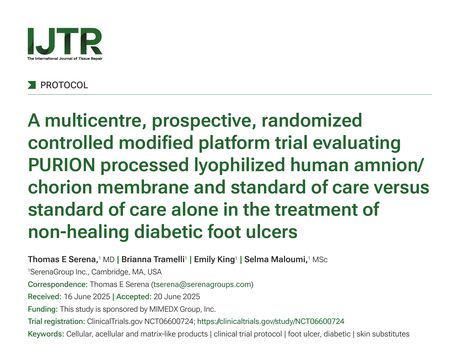
Serena, T. E., Tramelli, B., King, E., & Maloumi, S.
Aims: To evaluate the efficacy of PURION-processed lyophilized human amnion/chorion membrane (ppLHACM) products— EPIEFFECT and EPIXPRESS—in conjunction with standard of care (SOC) compared to SOC alone in the treatment of nonhealing diabetic foot ulcers (DFUs), using a novel modified platform trial design. Methods: This is a multicentre, prospective, randomized controlled trial utilizing a modified platform design. Patients with non-healing DFUs will be randomized into three groups: SOC alone or SOC plus one of two ppLHACM products. The primary endpoint is complete wound closure within 12 weeks. Secondary outcomes include time to closure, percentage area reduction, adverse events, and quality of life measured by the Forgotten Wound Score and Wound Quality of Life questionnaire. Exploratory objectives include assessment of offloading compliance, chronic inhibitory bacterial load, host protease activity, and continuous glucose monitoring data. Results: The results will be reported following trial completion. Once 50% of the target sample size has been enrolled and followed, an interim analysis is planned. Conclusion: This trial is expected to provide high-quality efficacy data on ppLHACM products and contribute to evidencebased practice in DFU management. The novel modified platform design offers a flexible and efficient approach to evaluating multiple interventions within a single clinical trial.
Cellular, acellular and matrix-like products, clinical trial protocol, foot ulcer, diabetic, skin substitutes
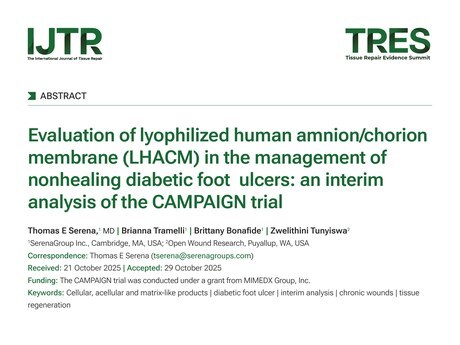
Serena, T. E., Tramelli, B., Bonafide, B., & Tunyiswa, Z.
Background: Diabetic foot ulcers (DFUs) are chronic wounds that contribute significantly to morbidity, mortality, and healthcare costs. Despite current standard-of-care (SOC) approaches, healing rates re-main suboptimal, emphasizing the urgent need for innovative and cost-effective treatment options. Methods: An interim analysis of this multicenter, prospective, randomized controlled platform clinical trial evaluated the efficacy of multiple lyophilized human amnion/chorion membrane (LHACMs) with SOC versus SOC alone. The primary endpoint was percentage of target ulcers achieving complete wound closure in 12 weeks, defined as 100% reepithelialization without drainage for two consecutive weeks, confirmed by blinded independent review. Results: The statistical analysis revealed that the treatment arm improved full wound closure at 12 weeks over SOC by 2.6 (credible interval: 0.81 – 5.0) in terms of relative. The estimated probability of complete wound closure under SOC was 23% (6.5%–42%), compared with 47% (37%–59%) under the treatment arm. This corresponds to a posterior absolute difference of 24% (4%–43%). This suggests a posterior probability advantage of 98.5% for LHACM. Conclusion: The interim analysis revealed that the placental membranes products trended to-ward superiority over SOC. Bayesian posterior estimates indicated 98.5% higher probabilities of wound closure and improved healing trajectories in the treatment group. These interim data provide early evidence of clinical benefit, subject to confirmation with full trial completion.
Cellular, acellular and matrix-like products, diabetic foot ulcer, interim analysis, chronic wounds, tissue
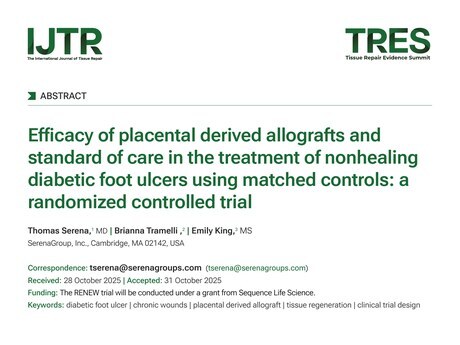
Serena, T., Tramelli, B., & King, E.
Diabetic foot ulcers (DFUs) are a severe complication of diabetes, contributing to high morbidity, risk of amputation, premature mortality, and substantial healthcare costs. Standard of care (SOC), including debridement, offloading, infection control, and moisture balance, remains the foundation of DFU treatment; however, many ulcers fail to achieve complete closure with SOC alone. Placental-derived allografts, classified as cellular, acellular, and matrix-like products (CAMPs), provide a biologically active extracellular scaffold rich in growth factors and struc-tural proteins that support angiogenesis, cellular migration, and control of inflammation. These properties suggest that CAMPs may overcome impaired healing pathways characteristic of chronic diabetic wounds. The RENEW trial is a multicenter, prospective, randomized controlled modified platform study designed to evaluate the effectiveness of multiple placental-derived al-lografts in combination with SOC using matched controls. Findings from RENEW aim to gener-ate high-quality evidence to guide integration of biologic therapies into clinical practice, improve healing rates, and reduce long-term complications of DFU.
diabetic foot ulcer, chronic wounds, placental derived allograft, tissue regeneration, clinical trial design
Serena, T. E., Tramelli, B., King, E., Shi, D., Bohn, G., & Breisinger, R.
Background: Diabetic foot ulcers (DFUs) represent a chronic and debilitating complication of diabetes, contributing substantially to patient morbidity, mortality, and economic burden. Despite advances in clinical management, outcomes with the current standard of care (SOC) remain suboptimal, with many ulcers failing to achieve complete closure. These limitations reinforce the need for innovative, cost-effective solutions that promote wound closure. Methods: This randomized controlled multicenter clinical trial evaluated the efficacy of single layer amniotic membrane (SLAM) plus SOC versus SOC alone in achieving complete closure of nonhealing DFUs over 12 weeks. The primary endpoint was complete wound closure, defined as 100% re-epithelialization without drainage for two consecutive weeks, confirmed by blinded independent review. Results: In Intent-To-Treat (ITT), the SLAM + SOC arm achieved a 13.1% closure rate versus 8.8% with SOC alone, with findings consistent in the Per-Protocol (PP) population. Additionally, the percent area reduction (PAR) from TV-1 to TV13 measured weekly with digital photographic planimetry and physical examination were analyzed. For ITT, SLAM + SOC outperformed SOC on both average and median wound‐area reduction. Conclusion: The interim analysis demonstrated that wounds managed with SLAM products trended toward superiority over those managed with SOC.
Cellular, acellular and matrix-like products, diabetic foot ulcer, interim analysis, chronic wounds, tissue
Serena, T. E., Tramelli, B., King, E., Shi, D., Dunn, M., Mehta, M., Simon, D., & Pavelescu, R. A.
Background: Diabetic foot ulcers (DFUs) are chronic wounds associated with high morbidity, mortality, and economic burden. Current standard of care (SOC) achieves less than optimal healing rates, highlighting the need for novel and costeffective therapies. Methods: An interim analysis of this multicenter, prospective, randomized controlled modified platform clinical trial evaluated the efficacy of multiple cellular, acellular, and matrix-like prod-ucts (CAMPs) with SOC versus SOC alone. The primary endpoint was percentage of target ulcers achieving complete wound closure in 12 weeks, defined as 100% reepithelialization without drainage for two consecutive weeks, confirmed by blinded independent review. Results: In Intent-To-Treat (ITT), the dual layer amnion/chorion membrane allograft (DLACG) with SOC arm achieved a 58.3% closure rate versus 13.3% with SOC alone, a 45% absolute gain that was statistically significant (n=12, 95% CI 15.7% to 68.4%, p=0.001, α=0.05). All other treatment groups were not significant in the ITT population. In Per Protocol (PP), analysis of the four-layer amniotic membrane allograft (FLAG) with SOC arm achieved a 63.6% closure rate versus 23.8% with SOC alone, a 39.8% absolute gain that was statistically significant (n=11, 95% CI 4.5% to 64.8%, p=0.027, α=0.05). All other treatment arms were not significant in PP population. Additionally, the percent area reduction (PAR) from TV-1 to TV-13 measured weekly with digital photographic planimetry, using an imaging device, and physical examination were analyzed. For ITT and PP populations, all treatment arms outperformed SOC on average and median wound‐area reduction. For PP, demographic summary statistics were analyzed to de-termine randomized baseline balance across groups, which was achieved with no statistically significant differences between groups at the time of interim analysis. Conclusion: The interim analysis revealed that the placental membranes products trended to-ward superiority over SOC. The statistical significance in the ITT population for DLACG suggests that this product is superior to SOC. This is an open access article under the terms of the Creative Commons BY-NC-ND lice
Cellular, acellular and matrix-like products, interim analysis, chronic wounds, diabetic foot ulcer, clinical
Serena, T. E., Tramelli, B., Booker, B., King, E., Shi, D., & Lantis, J. C.
Background: Venous leg ulcers (VLUs) are nonhealing wounds that pose considerable clinical and economic challenges. Healing outcomes with existing standard-of-care (SOC) remain limited, creating a pressing need for more effective therapeutic options Methods: An interim analysis of this randomized controlled multicenter clinical trial evaluated intact fish skin graft (IFSG) and SOC versus SOC alone in nonhealing VLUs. The primary end-point was the percentage of target ulcers achieving complete wound closure in 12 weeks, defined as 100% re-epithelialization without drainage for two consecutive weeks, confirmed by blinded independent review. Results: The statistical analysis revealed that the treatment arm trended toward improved full wound closure at 12 weeks over SOC by 1.52 (credible interval: 1.37–2.22) in terms of relative risk (Treatment/SOC). This translates to an improvement of 8.53% (credible interval: 5.60%-19.7%) in percentage terms. In the ITT population, the IFSG + SOC arm achieved a 47.6% closure rate versus 21.7% with SOC alone, a 25.9% absolute gain that was not statistically significant (n = 21, 95% CI -0.02% to 0.493%, p = 0.07, α = 0.05). In the ITT and PP population, IFSG + SOC achieved a higher mean area reduction than SOC. Conclusion: The interim analysis demonstrated a positive trend favoring IFSG products over SOC alone. While the present interim analysis provides promising early results, limitations inherent to its preliminary nature warrant consideration. The alignment of these interim findings with the broader body of evidence reinforces biological plausibility and strengthens confidence that the final analysis will yield clinically meaningful results supported by high-quality evidence.
Cellular, acellular and matrix-like products, venous leg ulcer, interim analysis, chronic wounds, clinical trial
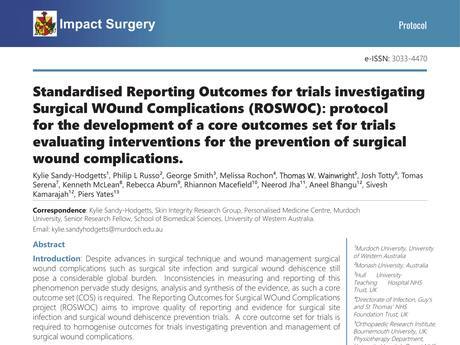
Serena, T., McGurk, S., King, E., Tramelli, B., Shi, D., & Breisinger, K.
Background: Chronic wounds such as pressure ulcers (PUs) cause physical, emotional and financial strain on patients. Amniotic membranes have been demonstrated in previous studies to aid wound closure. Methods: This study aims to examine the efficacy of cellular, acellular, and matrix-like products (CAMPs) in achieving complete closure of PUs that were not responsive to standard of care (SOC) treatment. Results: Overall, 25 subjects with 37 pressure ulcers that had failed to heal with 6 weeks of SOC were treated with threelayer placental derived allograft (TLPA) for up to 16 weeks. Mean age was 69.3 years, 16 patients were female, and 9 were male. At baseline prior to intervention, mean wound size was 44.9cm2 (SD 103.5) and three (8.1%) PUs achieved 40% or greater percent area reduction (PAR). At the end of TLPA treatment, 33 (89.2%) of PUs had a PAR of 40% or greater. Conclusion: TLPA treatment was shown to achieve 40% or more wound area reduction in this cohort of 25 subjects with 37 PUs that had not responded to SPC. The observed rate of improvement supports further investigation of TLPA in prospective controlled studies to validate efficacy, assess time to closure, and determine cost-effectiveness for PUs.
Amniotic membranes, cellular, acellular and matrix-like products, wound care, pressure ulcers
No publications match that search.
This library features peer-reviewed publications authored by SerenaGroup investigators across our clinical research programs.
Sponsors and investigators interested in working with our clinical research team can contact us at info@serenagroups.com.